Showing posts with label mind in the cave. Show all posts

Tuesday, 7 February 2012

More Thoughts on Communication Theory


Frame from the Piers Sanderson film: High on Hope

The interesting thing about communication is that it is a process by which we assign and convey meaning in an attempt to create a shared understanding. It requires both intrapersonal and interpersonal skills and it is through communication that we can develop collaboration and cooperation. As an old fashioned Socialist I strongly believe in communication as being at the core of all political activity and a lack of communication is usually at the core of organisational dysfunctionality and poor politics. I therefore worry about individualism. What can happen when the deep underlying reasons for collective, communal communication are lost is the rise of cultural fragmentation and individualism, a state that the Rowntree Foundation (Lawson and Thake, 2008) has argued as being one that needs to be confronted and replaced. "This individualism was seen to have damaging consequences, fuelling selfishness and greed and leading to isolation and fear as people struggle to cope and live fulfilling lives."

As DFGA Students you specialise in moving image communication techniques. We presume that a visual message with movement and sound has a greater power to inform, educate or persuade a person than a static visual. I.e. it is a synchronistic concept, whereby two or more forms of communication come together in order to achieve a powerful effect. In The Mind in the Cave by Lewis Williams (I do believe this is essential reading and I know I have mentioned it several times before) it is pointed out that sound, vision, dance and touch were all used to convey shamanistic messages to the tribe. Perhaps the rave is the clearest modern format for this. The film/music documentary ‘High On Hope’ which commemorates the 20th anniversary of acid house, telling the story of the infamous ‘Hardcore Uproar’ warehouse parties in Blackburn in the late nineteen eighties is a good illustration of this. Over 10,000 people dancing in cavernous warehouses across the north-west every week was the nearest to a Shamanistic experience I think we could get. For a brief moment perhaps our individualism is shed and we operate as one with the group.

You could say that one implication of communication theory is that evaluation of a good visual design/communication can be done by measuring the comprehension by its audience, not by aesthetic or artistic preference. In this case the problem in terms of communication theory is that if the people evaluating the art, media product or design are themselves media professionals they are too 'attuned' to the business to be aware of how a non media specialist would receive the communication. I.e. the best critics are those experiencing the communication, in the above instance the ‘ravers’.

Rhetoric
However it is within the old history of rhetoric that I find a deeply fascinating series of narratives. It is strange and wonderful and as it covers memory training, body language, voice projection as well as the well known 'rhetoric tropes'. It is indeed a deep river to fish. (To use the rhetoric trope 'metaphor'.)


An image from Yates: The art of memory

A key book to look at is I would suggest, ‘The Art of Memory' by Yates. For DGFA students this book can be an entry into a way of thinking of writing a film script as a memory aid (cues can help with memory retrieval) or developing a navigation theory for game design (Developing a system within which players' decisions are limited but significant). In fact if you follow Cicero’s rules for mind walking as a memory aid, you realise that the whole construct feels like an interactive video game. He suggests leaving odd, memorable images in significant places as you walk around a building. You ‘collect’ these as you retrace your memory steps, in a similar way to the collection of weapons or tokens as you navigate through a game. Cicero was when at work, a teacher of rhetoric to the powers that were in control in Rome. His texts were written to explain how rhetoric worked. What is interesting is that modern day computer games often outline how their ‘worlds’ work and there are several analogies between how Cicero pictured a controlled political environment and how game designers such as Hideo Kojima and Sid Meier set up the control systems for game parameters.
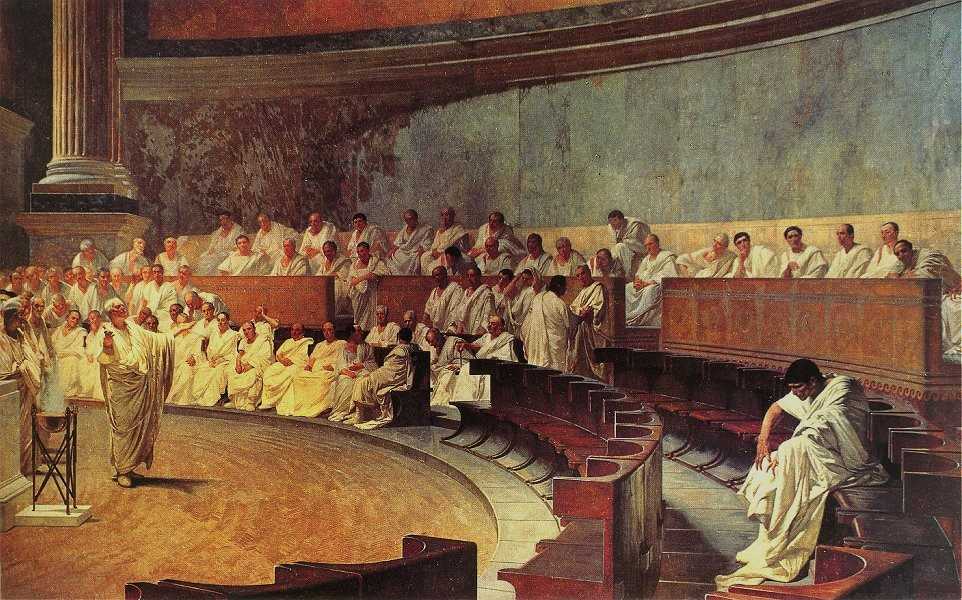

An orator speaks to the Roman senate

As Galloway (2006, p. 90) states in relation to a discussion of Meier’s work, “The gamer is learning, internalising and becoming intimate with a massive, multipart, global algorithm. To play the game means to play the code of the game.” I.e. you need to learn a process or set of rules in order to be able to calculate how to solve problems. This is very similar to Edward Channing’s (1856) definition of rhetoric; he stated, “rhetoric undertakes to show man rules or principles which will help to make the expression of his thoughts effective”. If you want to progress in a game such as ‘Civilization’ you need to internalize the logic of the program, once you understand the rules and principles you can make your thoughts effective. It could therefore be argued that a good game designer like Meier is someone that clearly understands how to use a contemporary type of rhetoric. In both cases, Cicero and Meier, their work can also be used to understand things about the wider political culture within which they both operate. In the game ‘Civilization’ the “massive electronic network of command and control”, as Galloway (2006) puts it, reflects the reality of contemporary power structures, whilst Cicero’s principles of rhetoric reflect the organizing principles of the Roman senate.


Sid Meier’s Civilization

Galloway., H. R. (2006) Gaming: Essays on Algorithmic Culture London: University of Minneapolis Press
Lawson, N and Thake, S (2008) Why individualism has created "social recession" York: Joseph Rowntree Foundation

Wednesday, 25 January 2012

Is film an art form? Part 2


Plato's Cave

The last post argued that stained glass is an art form; however it can come in very different formats. A Medieval cathedral round window, a narrow niche in a college foyer, a lamp shade etc. I think there has often been slippage as to what is considered an art form and what is a format. I would argue that a symphony is a musical format, so is a 3 minute pop record, someone singing in the bath and a folk song. Non of them necessarily are aesthetically pleasing unless they “provide a perceptual experience of pleasure, meaning, or satisfaction”. My problem now is the word ‘pleasure’. Is giving pleasure enough? We tend to associate ‘pleasure’ with ‘entertainment’ and disassociate the term from ‘meaning’. Perhaps this is a mistake. Much art is ‘difficult’; hard to understand, jarring, designed to shock etc. Modernism (as in Dada, Surrealism etc.) is often ‘transgressive’, which itself is defined as, “of or relating to fiction, cinematography, or art in which orthodox cultural, moral, and artistic boundaries are challenged by the representation of unconventional behaviour and the use of experimental forms”. So the old chestnut, “But that’s not art!” is perhaps not as simple to get round as we think it is. If an art form is “a conventionally established form of artistic composition”, if this convention is broken, is this not a way of therefore establishing the fact that what is there is not art? Again though there is the problem of ‘convention’. Who establishes this and why? Conventions have often been overthrown because they were out of date or put in place by power structures that have now been deposed. The avant-garde as a concept presumes that artists should operate at the boundaries of convention. Is this something to do with how a society establishes its ‘moral’ fabric? What is it right and proper for me to do as a member of society?
It might be of interest at this point to go back in time somewhat. Epicurus (341–270 B.C.) believed that knowledge is derived from the senses. The pursuit of pleasure and the avoidance of pain, were therefore at the centre of life’s decision making. He tried to demonstrate the differences between natural desires, (need for food etc) and artificial ones (need to pander to vanity, have more riches etc). He was looking to develop a philosophy that led to contentment of mind. He would therefore suggest that transgressive art forms were to be avoided as their assimilation could lead to a disturbance of mind. Inner peace or ‘ataraxia’ is what we should be aiming for. Therefore forms of art that lead to contemplation are what he would advise we should develop. All this however seems in opposition to Aristotle's ethical and social activism.
In Aristotle's Nichomachean Ethics Book VI he states: “What affirmation and negation are in thinking, pursuit and avoidance are in desire; so that since moral virtue is a state of character concerned with choice, and choice is deliberate desire, therefore both the reasoning must be true and the desire right, if the choice is to be good, and the latter must pursue just what the former asserts.”
In order therefore to make choices “reasoning must be true and the desire right.” So it isn’t enough to set out a clear reasoned argument for the establishment of an art form, the emotional need for art must also be given a voice.
My feeling is that emotional needs are linked to deep psychological drives and that these have been wired into us over thousands of years of evolution. It could be argued that human psychological traits are evolved adaptations to solve recurrent problems that have faced humankind in the various environments we have found ourselves living within. So why do we get pleasure or satisfaction in sitting together in the dark watching an illuminated screen of moving images?


Being inside a dark cinema is similar to being inside a cave or the womb


We have archeological evidence of human beings doing similar things over 30,000 years ago. In 1976 Richard Dawkins published ‘The Selfish Gene’, in this text he proposed that there was a way to look at culture from an evolutionary standpoint. He came up with the term ‘meme’ his word for a unit of culture that was supposed to be rather like a ‘gene’, something that is carried by a mind and that can be reproduced from mind to mind. In the same way that a gene is subject to the ‘survival of the fittest’ evolutionary test, a meme will survive if it is useful to us and our collective survival.
There is a wonderful book by David Lewis-Williams called ‘The Mind in the Cave: Consciousness and the Origins of Art’. He proposes a scenario where early humans collected together in caves to develop a particular set of rituals which were essential to collective survival. The shape and form of these rituals is I would argue still apparent within our present cultural products and activities. Williams describes a scene from 30,000 years ago, where people enter through a narrow passage that opens out into a cavern. The darkness is lit by flickering lights and images appear to almost move as the light flickers across the surface of undulating stone. Sounds of drumming fill the space and chants are sung and narratives told as social rituals are enacted. I’m sure certain modern forms of entertainment reflect these conditions quite closely. On the other hand, caves, in particular those structured in similar ways to the Rock Womb at Nenkovo, are clearly womb-like structures, the significance of which is inescapable.


Still from Herzog's 'Cave of Forgotten Dreams'

What really struck home with me however was Lewis-Williams’ description of the wall of the cave as a membrane. A surface that was understood as a barrier between the world of the living and the world of the spirit. It is an awareness of this divide and a need to come to terms with it that I feel lies at the core of what ‘art’, ‘religion’ , science’ and all our other forms of collective coming to terms with what’s out there are all about.

The psycho-analyst Lacan has a term called ‘the big other’. This is something that is so radically different to us that it goes beyond the imaginary. This term is usually linked to his understanding of constructions such as the law. However if we think of death as a passageway between what has life or ‘élan vital’ as Bergson would put it and what is inanimate or dead, the big issue is what is it that changes? At one moment a human being is alive, moves and has soul, at another there becomes no difference between a body and a stone, both exhibit complete inertia and are lifeless. This is a fundamental thing that we as conscious beings have to come to terms with. Perhaps all our ‘art’ forms are in one way or another simply trying to help us understand what it is to accept death as part of life’s experience. Without the development of culture our lives would be meaningless. In this sense culture has an intimate relationship with the development of religion. My experience of religious chanting or whirling dancing being at times not far away from my experiences in raves; my experiences in art galleries has at times reminded me of visiting a cathedral.

So is film an art form? Well yes and a powerful one. It brings together light, movement, sound and narrative in a collective environment and its images and stories attempt to make sense of the world. How many times as we leave a film with a partner do we end up discussing, “what was that all about?” What it was about was a meditation on the human condition. Whether or not it was a useful one, a deep one or a superficial one is another issue.